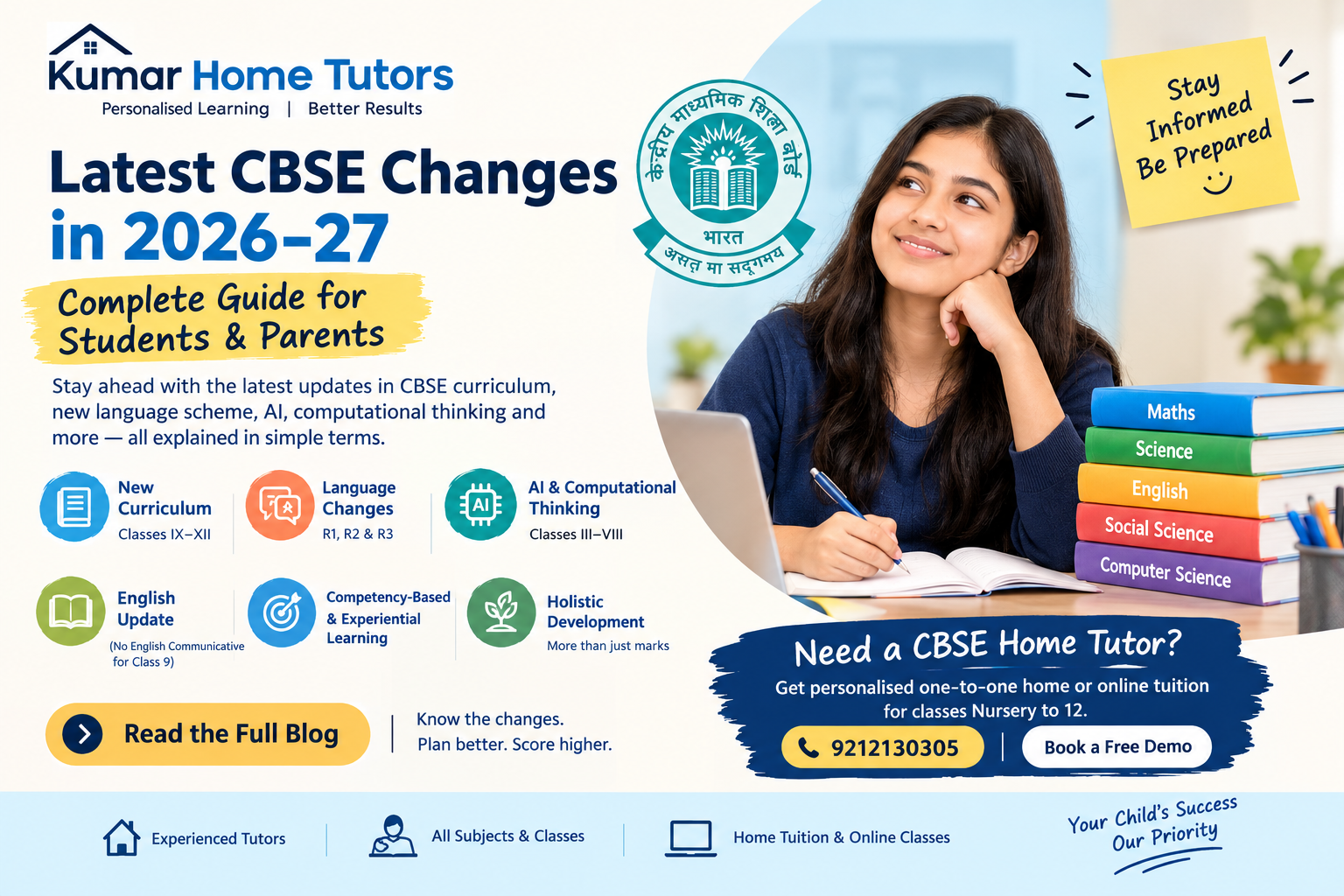
Latest CBSE Changes in 2026–27: Complete Guide for Students and Parents
The CBSE academic session 2026–27 brings important updates for students, parents and schools. From changes in the CBSE curriculum and language scheme to a greater focus on Artificial Intelligence, computational thinking, competency-based learning and holistic development, students need to understand what is new. In this complete guide, Kumar Home Tutors explains the latest CBSE changes in 2026–27 in simple language to help students and parents stay updated and prepare better for the new academic session.
Latest CBSE Changes in 2026–27: Complete Guide for Students & Parents
The academic session 2026–27 brings important changes for CBSE students, parents and schools. The Central Board of Secondary Education has introduced curriculum updates aligned with the National Education Policy (NEP) 2020 and the National Curriculum Framework for School Education (NCFSE) 2023.
The latest CBSE changes focus more on competency-based learning, understanding concepts, practical knowledge, flexibility and the overall development of students. Several important updates have also been introduced in languages, Artificial Intelligence, Computational Thinking and the curriculum for different classes.
In this complete guide, Kumar Home Tutors explains the major CBSE changes in 2026–27 and what students and parents should know.
1. New CBSE Curriculum for the Academic Session 2026–27
CBSE released the curriculum for Classes IX to XII for the academic session 2026–27. Schools and students are advised to carefully check the complete curriculum, including the introductory pages and subject-specific guidelines.
The new curriculum is designed around the principles of:
- Competency-based learning
- Experiential learning
- Conceptual understanding
- Flexible learning
- Holistic development
- Application of knowledge
- Reduced dependence on rote memorisation
Students should download and follow the latest syllabus for their class instead of depending only on old books or previous years’ study material.
2. Major Changes in Class IX Curriculum
One of the biggest CBSE changes in 2026–27 is the implementation of the new Scheme of Studies for Class IX in alignment with NCFSE 2023.
Class IX students will experience changes in the way subjects, languages and learning are structured. The focus is increasingly shifting from simply memorising information to understanding concepts and applying them in different situations.
Students entering Class IX should pay special attention to:
- Latest NCERT textbooks
- Updated CBSE syllabus
- Subject structure
- Language options
- Internal assessment requirements
- Competency-based questions
- Practical and experiential learning
CBSE also issued guidance and clarification regarding language choices for Classes IX and X.
3. Changes in the CBSE Language Scheme
The language scheme is among the important changes introduced for the 2026–27 academic session.
For Class IX, CBSE has provided a new structure for language choices under the updated Scheme of Studies.
Language Options for Class IX
Students can choose languages according to the CBSE guidelines and available levels.
For R1, the available options include:
- Hindi
- English
- Urdu
- Kannada
For R2, students can choose another language from the languages offered by CBSE, provided it is different from the language selected earlier.
CBSE has also clarified that the same language cannot be selected in both positions.
The exact language availability may depend on the CBSE guidelines and the school’s offerings.
4. English Communicative Discontinued for New Class IX Students
Another important update is related to English.
CBSE has discontinued the earlier English Communicative course for students entering Class IX from the 2026–27 academic session. There will be one English course as specified in the new syllabus.
However, Class X students in 2026–27 who had already studied English Communicative in Class IX can continue according to the applicable transition arrangements.
This means parents and students should carefully check the latest English syllabus and prescribed NCERT books before purchasing study materials.
5. Introduction of Third Language (R3) in Class VI
CBSE has introduced R3, or the third language, in Class VI as part of the 2026–27 Scheme of Studies.
This change is connected with the multilingual approach recommended under NCFSE 2023.
Schools are required to implement the third language according to CBSE guidelines and inform students about the language options available in their school.
The purpose of multilingual learning is to improve:
- Language skills
- Cultural understanding
- Communication abilities
- Understanding of Indian languages
- Overall learning development
Parents should contact their school to understand which R3 language options are available for their child.
6. AI and Computational Thinking Introduced for Classes III–VIII
Technology education is becoming increasingly important in schools.
For the 2026–27 session, CBSE introduced a Curriculum Framework for Computational Thinking and Artificial Intelligence for Classes III to VIII.
This is a major step towards preparing students for a technology-driven future.
The focus is not simply on using technology. Students are expected to develop skills such as:
- Logical thinking
- Problem-solving
- Computational thinking
- Understanding data
- Responsible use of technology
- Basic awareness of Artificial Intelligence
The introduction of CT and AI at an early stage can help students gradually develop important future-ready skills.
7. Greater Focus on Competency-Based Learning
CBSE continues to move towards a learning system where students are encouraged to understand and apply concepts.
Instead of only asking students to remember definitions and reproduce answers, competency-based learning focuses on questions that test:
- Understanding
- Application
- Analysis
- Reasoning
- Problem-solving
- Real-life connections
For example, students studying Mathematics should understand how to apply formulas. Science students should understand concepts and observations instead of only memorising answers.
This means students need to improve their conceptual foundation from the beginning of the academic session.
8. Experiential Learning Will Become More Important
The latest CBSE approach gives greater importance to learning through experience.
Experiential learning may include:
- Activities
- Projects
- Experiments
- Discussions
- Case-based learning
- Real-life examples
- Group activities
- Practical applications
Students should actively participate in classroom activities rather than focusing only on examination preparation.
This approach can help children understand subjects more deeply and remember concepts for a longer time.
9. New NCERT Books and Updated Learning Material
Students should always check whether new NCERT textbooks have been prescribed for their class.
CBSE and NCERT have continued updating curriculum and textbooks in line with the National Education Policy and the National Curriculum Framework.
Students and parents should avoid purchasing old study material without checking:
- Latest CBSE syllabus
- Latest NCERT textbooks
- Deleted topics
- Newly introduced chapters
- Updated examination requirements
CBSE also issued information regarding NCERT webinars on new textbooks for Grade IX during the 2026–27 session.
10. Focus on Holistic Development
The latest CBSE changes are not limited to academic marks.
The education system is increasingly focusing on the overall development of students.
This includes:
- Academic learning
- Physical education
- Mental well-being
- Art education
- Skill development
- Communication skills
- Technology awareness
- Social and emotional development
Students should therefore balance studies with activities that support their overall growth.
11. Skill Education Gets More Importance
CBSE offers various skill and vocational subjects to help students develop practical knowledge.
Students can explore subjects related to areas such as:
- Information Technology
- Artificial Intelligence
- Financial literacy
- Tourism
- Retail
- Marketing
- Beauty and Wellness
- Computer applications
- Other vocational skills
Skill-based education can help students explore different career paths and develop practical abilities alongside traditional subjects.
12. What Do These CBSE Changes Mean for Class 9 Students?
Class IX students are among those most directly affected by the updated curriculum and Scheme of Studies.
Students should focus on:
Understand Concepts
Do not study only to memorise answers. Understand why and how concepts work.
Follow the Latest NCERT Books
Always study from the books prescribed for the current academic session.
Practice Application-Based Questions
Try questions that require thinking and applying concepts.
Take Internal Assessment Seriously
Projects, activities and school assessments are important parts of the learning process.
Improve Language Skills
Students should understand the updated language options and requirements offered by their school.
Develop Technology Skills
Computational thinking and digital awareness will become increasingly useful.
13. What Should Class 10 and Class 12 Students Do?
Board class students should carefully follow the current CBSE syllabus and official examination updates.
For Class X and Class XII students, the best strategy is:
- Download the latest syllabus.
- Complete NCERT textbooks thoroughly.
- Understand concepts before memorising.
- Practice sample and competency-based questions.
- Revise regularly.
- Take school assessments seriously.
- Follow official CBSE announcements.
CBSE continues to publish examination-related circulars and updates separately on its official examination portal, so students should avoid relying on social media rumours.
14. How Parents Can Support Students in 2026–27
Parents may initially find the new curriculum and learning approach confusing. However, the best way to support children is to understand that modern education is gradually moving towards conceptual and competency-based learning.
Parents can help by:
- Checking the latest CBSE syllabus
- Buying the correct NCERT books
- Encouraging regular study habits
- Focusing on understanding rather than marks alone
- Talking with teachers
- Monitoring school updates
- Avoiding unnecessary academic pressure
- Providing additional support where required
CBSE’s own parenting guidance acknowledges that curriculum changes can create questions and concerns for parents and emphasises understanding the evolving academic approach.
15. How Kumar Home Tutors Helps CBSE Students
At Kumar Home Tutors, we understand that students need personalised academic support when curriculum and learning requirements change.
Our experienced home tutors and online tutors can help students with:
- CBSE Mathematics
- Science
- Physics
- Chemistry
- Biology
- English
- Hindi
- Social Science
- Economics
- Business Studies
- Account
- Computer Science
- Artificial Intelligence
- Class 9 preparation
- Class 10 preparation
- Class 11 and 12 preparation
We provide personalised one-to-one home tuition and online classes according to the student’s learning needs.
Our tutors focus on:
- Understanding concepts
- Completing the latest syllabus
- Solving application-based questions
- Improving weak subjects
- Regular revision
- Exam preparation
- Building confidence
Whether you need a home tutor in Delhi NCR or an online tutor for personalised learning, Kumar Home Tutors can help you find suitable academic support.
Tips for Students to Prepare for the New CBSE Session
Here are some simple tips for CBSE students in 2026–27:
1. Start With the Latest Syllabus
Check every subject and understand the chapters you need to study.
2. Study NCERT Properly
NCERT remains an important foundation for CBSE students.
3. Focus on Understanding
Ask questions whenever you do not understand a topic.
4. Practice Regularly
Regular practice is especially important for Maths, Science and other problem-solving subjects.
5. Make a Study Routine
Divide your time between school, homework, revision and activities.
6. Do Not Ignore Weak Subjects
Take help early instead of waiting until examinations are near.
7. Stay Updated With Official CBSE Announcements
Check official CBSE and school notifications for authentic information.
Frequently Asked Questions About CBSE Changes in 2026–27
What are the latest CBSE changes in 2026–27?
The major changes include updated curriculum for Classes IX–XII, implementation of the new Scheme of Studies for Class IX, changes in the language structure, R3 implementation in Class VI, and a Computational Thinking and AI curriculum framework for Classes III–VIII.
Is the CBSE syllabus changed for 2026–27?
CBSE released the curriculum for the 2026–27 academic session. Students should check the latest official syllabus and subject-specific curriculum for their class.
Is English Communicative available for Class 9 in 2026–27?
For students entering Class IX in 2026–27, the earlier English Communicative course has been discontinued under the updated scheme. Transition arrangements apply to eligible Class X students who previously studied it.
What is R3 in CBSE?
R3 refers to the third language under the updated language scheme. CBSE implemented R3 in Class VI from the 2026–27 academic session according to its guidelines.
Is AI introduced in CBSE schools?
CBSE introduced a Computational Thinking and Artificial Intelligence Curriculum Framework for Classes III–VIII for the 2026–27 session.
How can a home tutor help CBSE students?
A home tutor can provide personalised attention, help students understand difficult concepts, complete the latest syllabus, improve weak subjects and prepare effectively for school and examinations.
Final Thoughts
The latest CBSE changes in 2026–27 show a clear shift towards conceptual learning, competency-based education, practical understanding, technology awareness and holistic development.
Students should not be worried about these changes. Instead, they should understand the latest syllabus, study regularly and focus on building strong concepts.
Parents should stay connected with schools and follow official CBSE updates. If a student needs additional personalised support, a qualified home tutor or online tutor can help them understand the new learning approach and perform better academically.
Need a CBSE Home Tutor?
Looking for personalised academic support for your child?
Kumar Home Tutors provides experienced home tutors and online tutors for CBSE students from Nursery to Class 12.
📞 Call: 9212130305
Book a free demo class and find a suitable tutor for your child’s learning needs.